
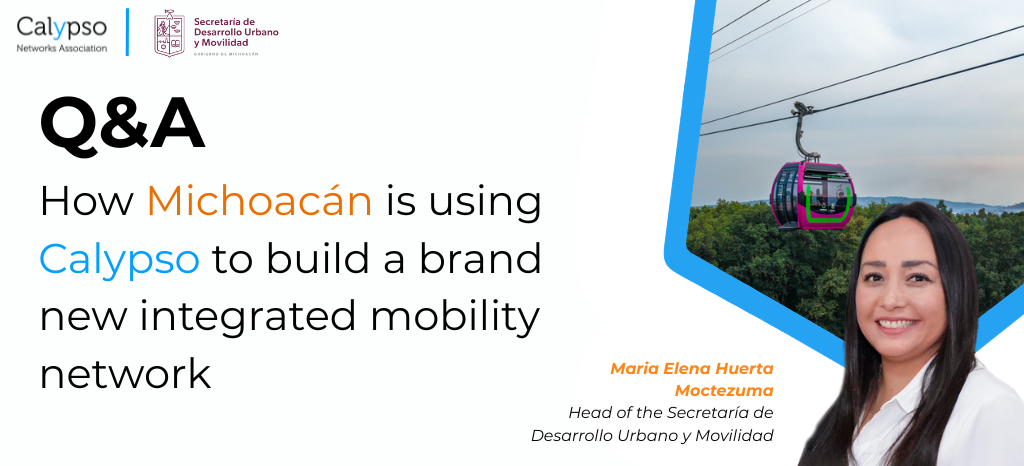
How Michoacán is using Calypso to build a brand new integrated mobility network
- By Chaix Manon
- In
What can you tell us about your role and aspirations within public transport?
As Head of the Secretaría de Desarrollo Urbano y Movilidad (SEDUM) in Michoacán, I’m responsible for leading the development of safer, more accessible, and better connected public transport across the region.
Michoacán is one of Mexico’s 32 states and has not seen significant investment in its public transport infrastructure for more than fifty years. During this time, transport services have been delivered through a fragmented network of individual concessions and independent operators. There has been no real integration between different types of transport, leaving many cities without the coordinated transport planning needed to support their growth.
Through SEDUM and our partners at the Instituto del Transporte del Estado de Michoacán (ITEM), we have been working to change this, developing our state’s first truly integrated mobility programme. This includes new cable car systems, the future Morebús BRT network, and modern fare collection technology – as part of a newly unified transport system.
Our aspiration is to improve the quality of life for people in Michoacán. That means safer journeys, more reliable services, and better accessibility. It also means making decisions based on technical needs and long-term planning, rather than short-term political cycles.
Why did Michoacán choose to use Calypso?
When we began developing our integrated mobility programme, we knew we needed a ticketing solution that could support multiple modes of transport from day one with room to further expand as we continue to grow the network of services.
Calypso stood out because of its security, maturity and proven ability to support large-scale integrated transport systems. We needed technology that could provide a strong foundation for long-term integration and interoperability, and Calypso provided us with a practical and proven route to creating centralised platform capable of supporting contactless ticketing across multiple transport services.
As we’re undertaking our first modern ticketing deployment, we benefited greatly from the support of Calypso’s technical experts, as well as the experience of the wider Calypso community, most notably our colleagues in Mexico City who have seen notable success with their Calypso implementation. The guidance provided during implementation was crucial in helping us navigate challenges and successfully launch this year.
Why are open standards so important to Michoacán?
Open standards are fundamental to our long-term vision of creating rich integrated systems. Michoacán has formally established a state-wide prepayment system through an official decree, and the Transport Institute is responsible for setting the technical guidelines that define how mobility operators and providers are integrated into this.
This is important because of how fast our transport network is expanding. Following the launch of the Uruapan cable car, we are preparing for the introduction of the Morebús BRT and the continued modernisation of local bus services throughout the state. Hundreds of vehicles will eventually be incorporated into the integrated fare system, alongside additional transport infrastructure.
Without open standards, we would end up with isolated solutions that don’t connect. With them, we can build a single ecosystem that different operators use in a consistent way, and which can enable wider use cases in the future, depending on our requirements.
Please tell us why Michoacán decided to implement Calypso Prime to support its transport infrastructure development?
We selected Calypso Prime because we wanted a solution that could support both our current requirements and our future ambitions.
As mobility in Michoacán evolves, we expect ticketing to become much more than a simple stored-value card. We want to support additional services, mobile applications, digital top-ups and future customer-facing innovations.
Calypso Prime gives us the flexibility and capacity to support those ambitions. While other Calypso specifications may become relevant for specific use cases in the future, Prime provides the strong foundation we need for launching a state-wide integrated transport programme and ensuring we are prepared for future developments.
How did you manage any challenges you encountered during your ticketing transformation?
This was the first deployment of its kind in Michoacán, so naturally there was a significant learning curve. We were not only introducing new ticketing technology, we also launched entirely new transport types and had to build the institutional processes needed to support them. Many of the challenges we encountered were therefore related to coordination, readiness and developing technical expertise within a rapidly evolving project.
Collaboration played a critical role. We worked closely with our implementation partners and relied on support from experienced members of the Calypso community during key phases of the deployment. This helped us address technical issues, refine processes and ensure the system was ready to support public operations.
Perhaps the most important lesson was that integrated ticketing is much more than a technology project. It requires coordination between transport authorities, operators, technology providers and policy makers. Building those relationships has been just as important as deploying the technology itself.
What’s next for Michoacán? Do you have plans for any future deployments of other Calypso specifications?
Early results following the launch of the Uruapan cable car have been extremely encouraging. Public adoption has exceeded expectations, passenger travel times have been reduced by around 50%, and operating hours have already been extended to meet this outstanding demand.
Our new offer has also proven particularly valuable for passengers with disabilities, who are using the infrastructure independently and in far greater numbers than originally forecast. With over 27,000 journeys already logged by those with disabilities, it is particularly pleasing to see that mobility is accessible to all.
The next major milestone will be the launch of the Morebús Bus Rapid Transit system in 2027. We will continue integrating additional bus services and operators into the unified fare system, gradually expanding the reach of the platform across the state.
We are also exploring new customer-facing services, including mobile ticketing via Host Card Emulation (HCE). These initiatives will help us better understand how digital ticketing can complement the existing card-based system.
Our immediate focus is on expanding and strengthening the existing integrated setup, but as the network grows and new passenger use cases emerge, we will continue evaluating additional Calypso specifications that could support occasional travellers, digital services and future mobility initiatives.
For us, the most important objective remains the same: creating a single, integrated mobility system, built on trusted standards that are free from vendor control, and which supports Michoacán’s transport network for many years to come.